Corcyra cephalonica, The Rice Moth
Moth at juvenile stage are most active and destructive. Under severe infestation entire food mass contaminated with webs and reduces its merchantability. Presence of live or dead larvae, their skin and castings in consignment either make them render less value or unfit for human consumption.
11/25/20253 min read
Corcyra cephalonica, The Rice Moth
Corcyra cephalonica, popularly known as rice moth or Indian Meal Moth, a serious pest in storage, especially for cereals like rice, maize, wheat, etc. The moths feed on a wide variety of dried vegetable materials, dried fruits like almonds, date palm, nuts, along with chocolates, biscuits, oilcakes etc (Adeyemi, 1968; Hodges, 1979). These are serious pests as they affect staple food items like rice and wheat, effective management is very much essential. The pest in India is known to cause 5-10% of loss in stored grains (Champ & Dyte, 1977, Tooba et. al., 2005). When they infest the seeds in storage, quality, quantity and viability are affected. Larval stage is very destructive as they feed on grains by either tunneling or feeding on surface. While feeding they produce silken threads to form webbings, thus contaminating them to loose their merchantability.
Biology of Corcyra Cephalonica
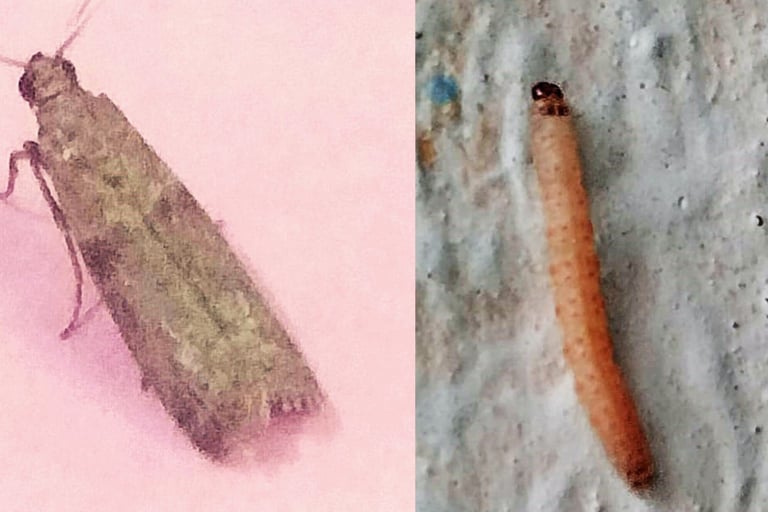
Adult females start laying eggs immediately after emerging, reach its peaks after few days. Eggs start hatching within 2-3 days. Eggs are laid scattered over the food mass, bags, containers. Eggs are creamy white in color, tiny in size, oval in shape, with thread like projection at one end. Temperature suitable for hatching and further development is 30 – 32.50C. The said temperature is more favoring along with 70% relative humidity. The juvenile stage is very destructive which undergo 7-8 instars. The caterpillars veraciously feed on food stuffs where as adults mainly meant for egg laying. Last instar caterpillar move to pupation stage where a double layered, well woven cocoons are formed on walls of the godowns, surface of bags or containers or cracks and crevices. Later well developed adults emerge from the pupa. The adults are pale and buffed in appearance. The hind wings are pale, where as fore wings are dull brownish or gray in color. Adults are mostly active after fall of night.
Economic damage by Rice moth
Moth at juvenile stages are most active and destructive. While feeding, the salivary glands of larvae start secreting sticky protein fiber which hardens when exposed to air. These fibers, bind the food grains or food particles to form a webs. These webbings act as protective shield against predators and adverse climatic conditions. Under severe level of infestation, entire food mass get contaminated with webs. Presence of live or dead larvae, their skin and castings in consignment either make them render less value or unfit for human consumption.
Management of Corcyra cephalonica
Integrated approach to be adopted to manage the rice moth. More care to be taken to use use safer chemical. Maintenance of hygiene is utmost important to reduce level of infestation. Regular inspecting and monitoring of the food grain sample is very important to detect the infestation initial stages which is easy to manage.
Up keep the hygiene of the storage unit: Godowns or any structure meant for food grain storage to be free from debris, cracks and crevices where the larvae may pupate and adult and larvae may shelter. Regular sweeping to be carried to remove spilled grains, dust and dirt in and around the storage unit. Surrounding the godowns to be kept clean from heap of damaged grains, vegetation, unused containers, jute bags. Cracks and crevices to thoroughly cleaned or vacuumed to remove hiding moths, larvae or pupa. Avoiding use of old jute gunnies or any other packing materials to make consignment from various stages of moths.
Use of light traps and pheromone traps: Corcyra, being nocturnal in habit, get attracted towards the light. Thus light traps attract the adult moths and help to capture and kill them. Thus helping to mitigate the adult population to the great extent.
On contrary, pheromone traps help to attract male moth by mimicking the scent or hormone produced by female moths. The traps includes synthetic female hormones to lure male insects, thus helps to trap and kill them. Thus, the absence or less number of male moth greatly affect the fertilizations of females and egg laying capacity. Thus reduces the next generation moths. Combined usage of both light and pheromones' traps are found most effective.
Use of Insect Growth Regulators like Methoprene: Methoprene is an Insect Growth Regulators which has shown some success against storage pests like rice moth. These mimic insects juvenile hormone, prevent the rice moth larvae to enter into stage of adulthood. Though it does not have immediate knock down effect, but try to reduce adult moths.
Chemically rice moths in storage can be controlled by fumigation with Alluminium Phosphide.
Newsletter
Sign up for our newsletter and get notified about all new posted articles.
ADDRESS
House No. 2-113(P), Visnumurthynagar, Kelarkalabettu, Thenkanidiyuru, Udupi
cONTACT
7975809540
satishmqc362@gmail.com